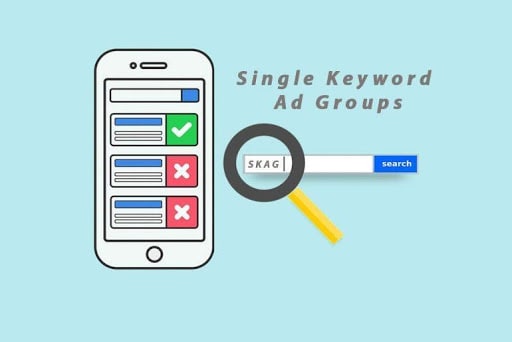
A single-keyword ad group, often shortened to SKAG, places one positive keyword in an ad group. Its purpose is tight control of the relationship between a keyword, ad and landing page. It is one account structure to assess, rather than a general route to lower costs.
Table of Contents
Understand what one keyword can match
A single keyword does not mean a single search query. Google’s exact match can cover searches with the same meaning or intent. Phrase and broad match have different reach, and the search terms report gives only the queries Google makes available.
Older SKAG instructions often repeated close keyword variants or used broad match modifier notation. Broad match modifier is no longer available as a separate matching behaviour. Reproducing an old account template does not reproduce the matching rules that existed when it was written.
Start with the offer and landing page
Consider whether the search task needs a distinct message or destination. A narrowly defined product with a dedicated page may justify separate control. Closely related terms that lead to the same offer may be easier to manage together in a themed ad group.
For example, a company selling one specialist replacement part might need a dedicated message about compatibility. A general service with several synonymous search terms may not benefit from a separate ad group for every wording variation. These are planning examples, not tested performance findings.
Compare the operating trade-offs
- Message control: a narrow group can support a specific offer, while a themed group can cover related searches with a consistent message.
- Evidence: many small groups can leave individual decisions with sparse outcome data. Combining unrelated needs can make a shared result hard to interpret.
- Maintenance: every extra group needs current ads, destinations, negatives and quality checks.
- Automation: evaluate the structure alongside the campaign’s bidding and matching approach. Search, Shopping, Display and other campaign types do not share identical controls.
Test a change without assuming an improvement
Document the current structure, search tasks, spend, recorded conversions and qualified outcomes. State why a different grouping might help and what result would justify keeping it. Keep other important changes controlled where possible.
Check ad relevance and landing-page suitability, then assess the same outcome definitions over a useful review period. Allow for conversion delays and changes in demand. A rise in clicks or a platform score does not prove that acquisition became more efficient.
If the account does not have trustworthy conversion measurement, resolve that before using a restructuring result to make a budget decision. Choose a structure the team can explain and maintain.
Discuss the work you need
Google Ads management can help define the scope and responsibilities for your project. Discuss your project with VSA. The form starts an enquiry about your needs.